Advertisement


There is something about Spider-Man that makes the character feel inseparable from the city he protects. New York is not merely the backdrop to Peter Parker’s story; it is part of his identity. The skyscrapers, crowded streets, bridges, rooftops, yellow taxis and endless movement give Spider-Man the playground that makes his web-swinging believable.
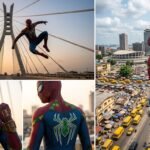
But watching Spider-Man: Brand New Day, I kept asking myself one strange question: What if Spider-Man was not swinging through New York? What if Peter Parker was living in Lagos?
And honestly, Lagos would give him one hell of a playground.
Spider-Man: Brand New Day takes Tom Holland’s Peter Parker into a more mature phase of his life. This is no longer the wide-eyed teenager we met in Homecoming. The character has been through loss, isolation and the consequences of being Spider-Man, and the film appears far more interested in what being a superhero does to Peter emotionally than simply throwing another villain at him.
That shift has been one of the strongest points in the reaction to the film. Early audiences and critics have repeatedly highlighted Holland’s more emotional performance, the film’s darker but hopeful tone, its action and its visual style. Some have even called it the strongest entry in Holland’s Spider-Man run, while others have praised it as a much-needed reset after No Way Home.
And that is probably what makes the film interesting to Nigerian viewers. Spider-Man has always worked because Peter is not Superman. He is not some untouchable god flying above humanity. He is a young man trying to survive life while simultaneously trying to save everyone around him.
Put that person in Lagos and you have something potentially extraordinary. Imagine Peter Parker living somewhere around Yaba.
He is broke, constantly late, trying to pay rent, doing some freelance photography or tech work while secretly spending his nights stopping criminals. He has no billionaire backing him. No fancy tower. No private laboratory.
Just Peter, his suit and Lagos traffic. Now imagine him trying to get from Yaba to Victoria Island. He does not take a car. He swings. And suddenly the city becomes part of the action.
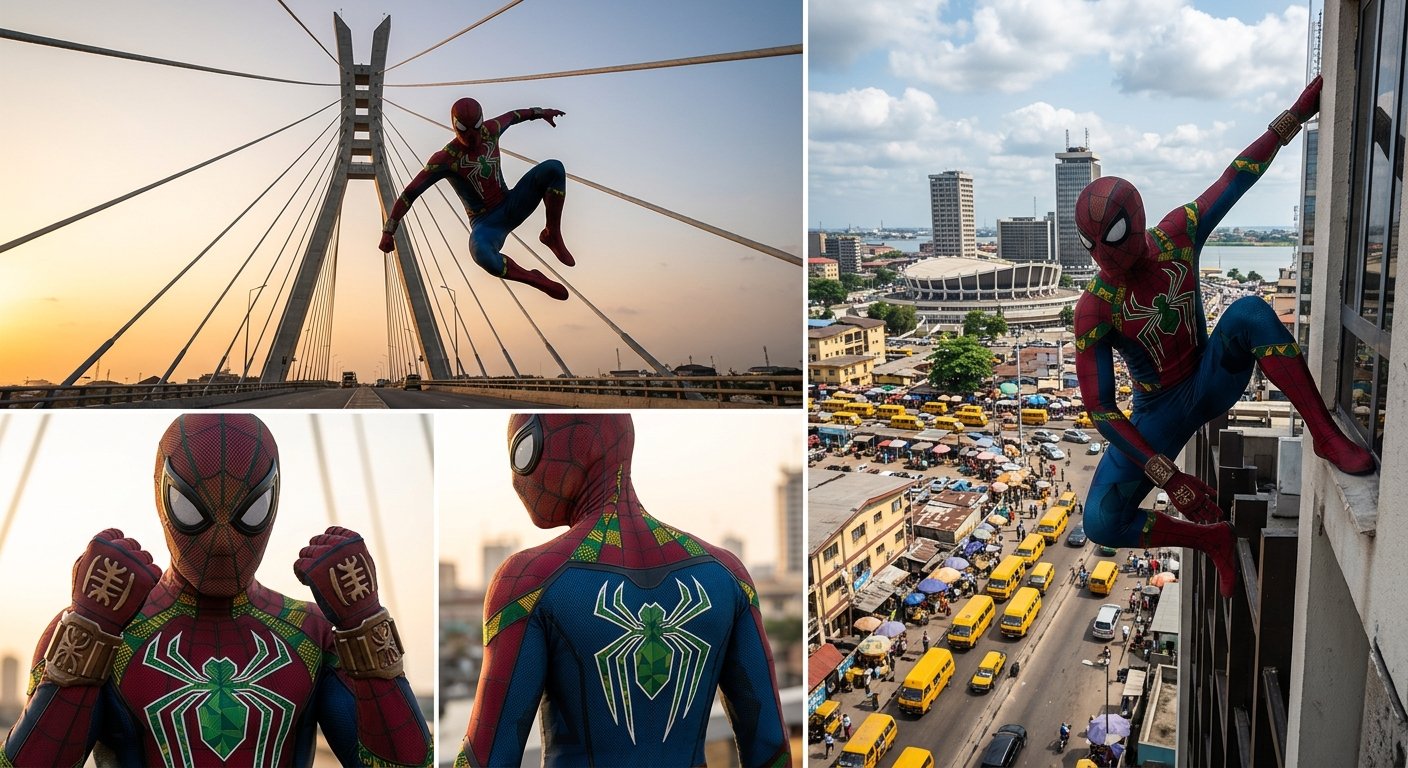
From Yaba, Spider-Man could swing across the Third Mainland Bridge, disappear between the vehicles stuck in traffic and land somewhere around Lagos Island. He could move through the skyline of Marina, jump across rooftops around CMS and disappear into the crowded streets of Idumota.
That would not simply be Spider-Man transplanted into Nigeria. It would be Spider-Man redesigned by Lagos.
If I were the cinematographer, the Third Mainland Bridge would be one of my first locations.
There is something almost perfect about it for Spider-Man. Imagine a night sequence with Lagos glowing beneath him. The headlights of thousands of vehicles forming streams of light while Spider-Man swings underneath and above the bridge. The camera follows him from behind before suddenly moving into a wide aerial shot revealing the enormous Lagos landscape.
Then the villain appears. A massive fight breaks out on the bridge while traffic is trapped around them.
Now imagine Nigerian drivers. One man is pressing his horn because Spider-Man has landed on his bonnet. Another is shouting, “Oga, shift!” A danfo driver is somehow trying to overtake both Spider-Man and the villain.
That is where Nigerian humour would enter the film naturally, and the world would absolutely love it.
Because one of the things that makes Lagos visually fascinating is that the city does not stop moving simply because something extraordinary is happening.
The Lekki-Ikoyi Link Bridge would provide another spectacular location. Its curved cable structure would give Spider-Man something visually different from the traditional New York skyscraper environment. A night-time chase across the bridge, with the Lagos skyline glowing in the background, could produce some of the most beautiful Spider-Man imagery ever put on screen.
Spider-Man swings underneath the bridge as the camera rotates around him. He releases the web and falls. For a moment, everything goes silent. Then another web shoots across the frame and he swings back upwards. Cut to a wide shot of Lagos.
That is the kind of sequence that could become an instantly recognisable image for a Nigerian Spider-Man film.
But if the filmmakers really wanted to do something different, they would take Spider-Man to Makoko. This would be one of the most visually distinctive settings in the entire film.
Instead of skyscrapers, Spider-Man would be moving across wooden structures and waterways. Instead of swinging between buildings, he would leap between rooftops and boats, using his webs to move across the water.
And there would be an important storytelling opportunity here because Spider-Man has always been a neighbourhood hero.
So imagine Peter discovering that some of the people who need him most are not living in the wealthy parts of Lagos but in communities that rarely make it into blockbuster cinema. The film could use Spider-Man’s powers to tell a much more grounded story about ordinary people.
That would be far more interesting than simply bringing an American superhero into Nigeria and pretending Lagos is another New York.
If there is one place that could capture the chaotic energy of a Lagos Spider-Man movie, it would be Lagos Island. The crowded streets around Balogun and Idumota could give the film something New York cannot replicate.
Spider-Man could be chasing a criminal through a market. People are screaming, traders are shouting, someone is filming the fight on their phone, and another person is trying to sell something in the middle of the chaos. Spider-Man jumps onto a moving vehicle, the vehicle keeps moving, and nobody stops.
And somewhere in the background, somebody is already shouting, “Na Spider-Man be this?”
That would be Lagos. Not polished. Not quiet. Not predictable. But incredibly alive.
Then, when the film needs to become enormous, take Spider-Man to Eko Atlantic. The contrast would be beautiful.
You could have the old and new Lagos existing within the same movie. One minute Peter is fighting through the chaotic streets of Lagos Island. The next, he is standing against a futuristic skyline at Eko Atlantic.
That visual contrast could become one of the film’s major themes: old Lagos versus new Lagos, tradition versus modernity, and the city people inherited versus the city people are building.
Spider-Man would be moving between both worlds. And that is exactly what Peter Parker himself represents. He is constantly caught between being an ordinary young man and something much bigger than himself.
Forget the glamorous locations for a moment. If Marvel really wanted to make Nigerians laugh, they would put Spider-Man in Ojuelegba.
Imagine him chasing a villain through Lagos traffic. He swings onto a danfo. The driver looks at him. Spider-Man says, “Sorry.” The driver says, “Sorry for what? Pay your transport!”
That scene alone would probably become a meme before the movie even finished playing in Nigerian cinemas. And that is one thing Nigerian filmmakers could bring to Spider-Man that Hollywood sometimes struggles to replicate: the ability to mix enormous spectacle with everyday humour.
Nigerians would not simply watch Spider-Man. They would talk to Spider-Man.
If Spider-Man: Brand New Day were actually produced in Lagos, Nigerian social media would probably explode.
There would be arguments about which Lagos neighbourhood Peter Parker should live in. People would debate whether Spider-Man should speak Pidgin. There would be TikTok videos recreating his swings. Someone would definitely create a skit about Spider-Man being stopped by LASTMA.
And somebody would ask the most Nigerian question of all:
“How much did they spend to shoot this?”
But underneath all the jokes, I think Nigerians would genuinely connect with the character. Peter Parker is fundamentally a struggling young man. That part of his story translates almost anywhere.
The idea of somebody trying to survive, pay bills, find love, protect family and still do the right thing despite everything going wrong is not uniquely American.
It is universal. And Lagos understands struggle. Internationally, the reaction could be even more interesting. For audiences outside Nigeria, Lagos would be almost as much of a character as Spider-Man.
The colours, the traffic, the markets, the ocean, the bridges, the architecture, the nightlife, the people, the noise and the sheer density of the city could all give Spider-Man a completely different visual identity.
All of these things could give Spider-Man a completely different visual identity.
And importantly, it would allow the world to see Lagos through a cinematic language usually reserved for cities such as New York, London, Tokyo and Los Angeles.
Hollywood has spent decades making New York look like the centre of the superhero universe.
Imagine Lagos receiving that treatment.
Imagine a $200 million Marvel production spending months capturing the city from above, below and within.
The international audience would probably spend as much time discussing Lagos as they did Spider-Man.
But this is where I would be critical. The filmmakers would have to resist the temptation to turn Lagos into a collection of stereotypes.
Do not give us only traffic, poverty, markets and chaotic streets. Lagos has luxury apartments, technology companies, art galleries, beaches, nightlife, universities, historic neighbourhoods, religious centres, massive business districts and some of the most visually contrasting urban environments in Africa.
A proper Lagos Spider-Man film would need all of it. It should show the beauty and the madness, the wealth and the struggle, the old city and the new city, the quiet mornings and the chaotic evenings.
Because that contradiction is what makes Lagos cinematic.
One of the strongest elements of Brand New Day has been its visual approach. Critics have praised its cinematography, dynamic action and colour grading, while the cinematographer Brett Pawlak has spoken about deliberately using composition and framing to evoke the visual language of Spider-Man comics.
That same philosophy could work brilliantly in Lagos.
Imagine the deep reds and blues of a Spider-Man suit against the orange glow of Lagos traffic at sunset. Imagine Spider-Man silhouetted against the Lagos skyline, rain falling over Marina while he sits on a rooftop, a sunrise over the Lagos Lagoon, or him swinging between buildings while the city wakes underneath him.
Lagos has the visual ingredients. What it needs is the right cinematographer.
That is ultimately the question the film asks. After the emotional destruction of No Way Home, Peter Parker is no longer the same person.
Brand New Day appears more interested in that damaged, lonely and increasingly mature version of Peter. The early reactions suggest that this emotional direction has worked for many viewers, even as some criticism has been directed at pacing and the film’s sometimes overloaded storytelling.
And I think that is why the movie has resonated. Peter is growing up and discovering that being Spider-Man is not about getting applause. It is about responsibility. Sometimes it means being alone, sometimes it means losing people, sometimes it means saving someone who will never know your name, and sometimes it means waking up the next morning and doing it all over again.
That is the real meaning behind the “Brand New Day”.
Spider-Man: Brand New Day succeeds because it understands that Peter Parker does not need another multiverse crisis every five minutes to be interesting. He needs a city, a problem and a reason to keep getting back up.
The film’s more mature emotional direction, Tom Holland’s performance, the action and the visual ambition have clearly connected with audiences, although the pacing and sheer number of story elements can occasionally work against it.
But watching it as a Nigerian, I could not stop imagining what this character would look like above Lagos. And honestly?
Spider-Man in Lagos would be insane.
Give him the Third Mainland Bridge, Lekki-Ikoyi Link Bridge, Lagos Island, Makoko, Yaba, Eko Atlantic, Ojuelegba, Lagos traffic, Nigerian humour and the Lagos Lagoon at sunset.
Then let the camera pull back as Spider-Man swings across the city and thousands of people look up.
For the first time, the world would not be looking at New York through Spider-Man’s eyes.
It would be looking at Lagos.
And I suspect Nigerians would spend the first week arguing about whether the movie got Lagos right, while the rest of the world would be asking one question: “When is Spider-Man coming back to Lagos?”